

Most people think of cosmetology school as the starting line. But if you already know beauty is the direction you’re heading, there’s no reason to wait until enrollment to start building the foundation.
The skills you develop in high school can give you a genuine head start when you walk into your first cosmetology program. Here’s a look at which cosmetology high school courses are worth paying attention to if a beauty job is on your radar — and exactly what to do once you graduate.

Art
This one probably isn’t surprising, but it’s worth going deeper than the obvious connection. Cosmetology is a visual craft. Whether you’re formulating color, designing a haircut, or planning a makeup look, you’re making constant decisions about proportion, contrast, balance, and tone. Art classes build the visual vocabulary that makes those decisions more instinctive.
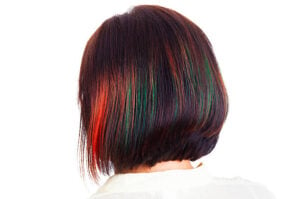
Color theory in particular is something you’ll encounter directly in cosmetology training — understanding warm and cool tones, complementary colors, how pigments interact — and having even a basic grounding in it before you start makes a real difference. The same goes for concepts like symmetry, negative space, and how light affects the way color reads on different surfaces.
Beyond the technical side, art classes also train you to look more carefully. That kind of observation — noticing what works, what doesn’t, and why — is something the best stylists and estheticians do constantly, even when they’re not consciously aware of it.
Chemistry and Biology
Two of the most essential classes to take for cosmetology in high school are chemistry and biology. Cosmetology involves a significant amount of chemistry, and this catches some people off guard. Every time a colorist mixes a formula, applies a relaxer, or performs a keratin treatment, they’re working with chemical reactions that affect the structure of the hair. Understanding what’s actually happening at that level — how oxidation works, why pH matters, how different compounds interact — makes you a safer and more effective technician.
Chemistry knowledge also helps you troubleshoot. When a color doesn’t turn out as expected or a chemical service behaves differently than anticipated, a stylist who understands the underlying science has a much better shot at figuring out why.
Biology is equally relevant, especially if you’re drawn toward esthetics. Skincare work requires a solid understanding of skin anatomy — the layers of the skin, how follicles and glands function, how the skin responds to different treatments and environments. Even if you’re focused primarily on hair, biology gives you the foundation to understand hair structure, growth cycles, and scalp health, all of which come up regularly in cosmetology training.
For more on how science intersects with hands-on beauty work, our guide on advanced facial treatments for estheticians shows how much technical knowledge goes into even a single service.
Mathematics
Math might feel like the most unexpected subject on this list, but it shows up in cosmetology more than most people realize — and the further you go in your career, the more it matters.
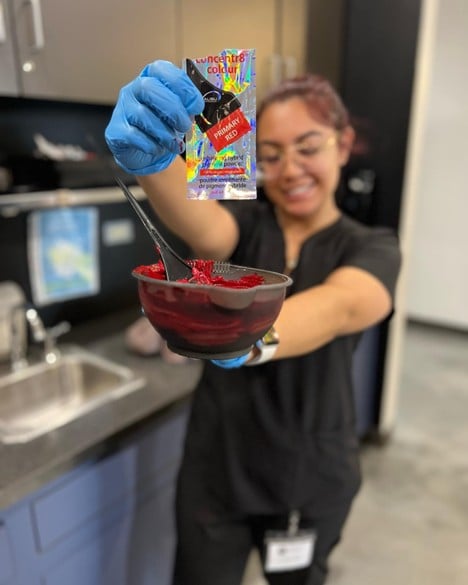
On the practical side, color formulation involves ratios. You’re measuring developer to color, adjusting formulas based on the result you’re going for, and scaling those proportions up or down depending on hair density and length. Getting comfortable with percentages and basic arithmetic makes this faster and more accurate.
On the business side, math becomes even more critical. Many cosmetologists work as booth renters or independent contractors, which means they’re responsible for setting their own service prices, tracking their expenses, calculating quarterly taxes, and understanding whether their business is actually profitable. These aren’t things that can be outsourced easily, and the stylists who struggle with them often find the business side of their career more stressful than it needs to be.
If salon ownership is something you’re thinking about down the line, the math requirements go up considerably — overhead, payroll, inventory, profit margins. A strong foundation in math, and ideally some exposure to basic accounting concepts, is genuinely useful preparation. Our guide on how to open a salon in Illinois gives a good sense of what that business side actually involves.

Communications
The technical side of cosmetology gets most of the attention, but the ability to communicate well with clients is just as important to a successful career — and it’s a skill that takes real development.
Think about what a client consultation actually requires. You need to understand what the client is envisioning, often from vague descriptions or a phone photo that may not match their hair type at all. You need to set realistic expectations without dismissing what they want. You need to ask the right follow-up questions and make them feel heard and confident in your judgment. That’s a nuanced conversation, and it happens before you’ve even picked up a comb.
English and communications classes — anything that involves public speaking, persuasive writing, active listening, or debate — build the kind of verbal clarity and social attunement that make those conversations go better. Drama and theater can be surprisingly useful here too, since they train you to read a room and adjust your delivery in real time.
The relationship side of cosmetology also matters enormously for long-term career success. Clients who trust their stylist come back. They refer friends. They buy the products you recommend because they believe you’re recommending them for the right reasons. That trust is built through communication, and it compounds over time.
Physical Education and Sports
This one genuinely surprises people, but the physical demands of cosmetology work are real. A full day behind the chair means six to eight hours on your feet, often without much of a break. Your arms are raised for extended periods. Your hands are working constantly — and the fine motor precision required for detailed work like nail art, precision cuts, or skin treatments is actually significant.
Physical stamina, core strength, and joint health all play into how sustainable a cosmetology career is long-term. Stylists and estheticians who don’t take their physical condition seriously often find themselves dealing with back pain, wrist issues, or fatigue that affects both their work quality and their wellbeing.
Sports and gym classes that build endurance, improve posture, and develop body awareness are genuinely useful preparation. Activities that involve fine motor skill — gymnastics, rock climbing, certain racket sports — can also help develop the dexterous hand control that detailed beauty work requires. Taking care of your body isn’t just a wellness topic — it’s a career longevity topic.
Business and Entrepreneurship
If your school offers any business or entrepreneurship electives, they’re worth taking seriously. The beauty industry has an unusually high percentage of self-employed professionals — booth renters, suite owners, freelancers, salon owners — and understanding the basics of how a business runs is valuable from relatively early in your career.
Topics like basic accounting, marketing, customer service, and entrepreneurship all translate directly. Even soft business skills — time management, professionalism, follow-through — matter in an industry where your reputation is built one client at a time. Our overview of top-paying beauty careers in Illinois is a useful starting point for understanding what different paths in the industry actually look like financially.

What to Do After High School: A Practical Step-by-Step Guide for Illinois
Knowing which are the most important classes in high school for cosmetology is only half the picture. Once you’ve graduated — or you’re close to it — the path forward in Illinois is more straightforward than most people realize. Here’s exactly what it looks like, step by step.
Step 1: Make Sure You Meet the Basic Requirements
To enroll in a cosmetology program in Illinois, you need to be at least 16 years old and have a high school diploma or GED. That’s it. You don’t need prior beauty experience, a portfolio, or any specific coursework beyond that baseline.
If you’re still in high school and at least 16, some programs may allow you to enroll concurrently — worth asking about if you’re eager to get started early.
Step 2: Choose Your Program and Specialty
Illinois licenses several different beauty specialties, and they’re not all the same program. The most common paths are:
Cosmetology — The broadest license, covering hair cutting, coloring, chemical services, and basic skin and nail work. This is the most versatile option and what most people picture when they think of beauty school.
Esthetics — Focused entirely on skincare: facials, waxing, chemical exfoliation, and related treatments. A shorter program than cosmetology but more specialized.
Nail Technology — Focused on nail care, manicures, pedicures, nail enhancements, and nail art.
Barbering — Hair cutting and grooming with a focus on short hair, fades, and beard work.
Each requires a different number of training hours and leads to a separate Illinois license. If you’re not sure which path fits you best, our breakdown of cosmetologist vs. esthetician vs. barber walks through the differences clearly.
Step 3: Complete Your Required Training Hours
Illinois sets minimum hour requirements for each license. Here’s what that currently looks like:
- Cosmetology: 1,500 hours
- Esthetics: 750 hours
- Nail Technology: 350 hours
- Barbering: 1,500 hours
These hours are completed at an accredited school — not on your own. Full-time programs move faster; part-time or evening programs take longer but offer more flexibility for people who are working or have other commitments.
At Cosmetology & Spa Academy, a full-time cosmetology program typically takes around 12 to 14 months to complete. Part-time schedules extend that timeline but cover the same curriculum and the same number of hours. For a more detailed breakdown of what that timeline looks like, our guide on how long cosmetology school takes in Illinois covers it thoroughly.
Step 4: Apply for Financial Aid Early
Cosmetology school is an investment, and there’s real financial support available — but you have to apply for it. The Free Application for Federal Student Aid (FAFSA) is the starting point. Accredited cosmetology programs can qualify for federal grants (including Pell Grants, which don’t need to be repaid) and federal student loans.
File your FAFSA as early as possible — aid is often distributed on a first-come basis and the earlier you apply, the more options you have. Our financial aid page covers how to pay for beauty school including grants, scholarships, and what to expect from the process.
Step 5: Complete the Program and Apply for Your Illinois State Board Exam
Once you’ve finished your required hours, you’ll apply to sit for the Illinois State Board exam. This is a two-part test: a written (theory) section and a practical (hands-on) section.
The theory exam covers topics like sanitation and safety, hair and skin science, chemical processes, and state regulations. The practical exam requires you to demonstrate specific technical skills on a mannequin or live model, depending on the exam format.
Passing both sections is required to receive your Illinois cosmetology license. Schools prepare students for the board exam throughout the program — it’s not something you study for at the last minute. Our cosmetology state board exam guide walks through exactly what to expect and how to prepare.
Step 6: Get Licensed and Start Working
Once you pass the board exam, you apply for your Illinois license through the Illinois Department of Financial and Professional Regulation (IDFPR). The license needs to be renewed every two years and requires a small number of continuing education hours to maintain.
From there, you have real options. You can take a position at an established salon to build your clientele and technique. You can rent a booth and work independently from the start. Or you can work toward eventually opening your own space. The license is the same regardless of which direction you go — what differs is how you build from there.
A Realistic Full Timeline
For someone graduating high school and enrolling in a full-time cosmetology program shortly after:
- Months 1–14: Complete 1,500 training hours at an accredited program
- Month 14–15: Apply for and sit the Illinois State Board exam
- Month 15–16: Receive your license and begin working
That means many students are fully licensed and working in the industry within about 14 to 16 months of finishing high school. That’s a fast path to a real career — and it doesn’t involve years of general education courses that aren’t relevant to what you actually want to do.
The Bigger Picture
What all of these high school subjects have in common is that they build something you’ll use for the entire length of your career — not just the first year of cosmetology school. The stylists and estheticians who thrive long-term tend to be the ones who brought more than technical skill to the table. They brought curiosity, business sense, physical awareness, and the ability to genuinely connect with the people sitting in their chair.
High school is a good time to start developing all of that intentionally. You don’t need to have everything figured out — but knowing the direction you’re heading gives you the chance to make those years count in a way that actually serves your future.
If you’re ready to understand what training at Cosmetology & Spa Academy looks like, our cosmetology program page covers the curriculum, schedule options, and what students work toward.
Frequently Asked Questions
Do you need any specific classes to get into cosmetology school?
Most cosmetology programs in Illinois require a high school diploma or GED rather than any specific coursework. The subjects in this guide will make your training easier and more intuitive — but they’re preparation, not prerequisites.
Is cosmetology school hard if you don’t have an art background?
Not having formal art training won’t hold you back. Cosmetology programs teach color theory and design fundamentals as part of the curriculum. An art background just means some of those concepts will feel familiar sooner. What matters more is genuine interest and willingness to practice.
How much math is actually involved day-to-day?
For most services, it’s basic ratios and arithmetic — mixing color formulas, measuring product amounts. The math becomes more significant if you work independently or own a business, where you’re managing pricing, expenses, and taxes yourself.
Can I start cosmetology school before I finish high school?
In Illinois, you need to be at least 16 and have a high school diploma or GED to enroll. Some programs may accept concurrent enrollment if you’re still in high school and meet the age requirement — it’s worth asking the school directly.
How long does it take to get a cosmetology license in Illinois?
Full-time cosmetology programs typically take 12 to 14 months to complete the required 1,500 hours. Add a month or two for the board exam and licensing process, and most students are fully licensed within 14 to 16 months of starting school.
What if I’m not sure whether I want to do hair, skin, or nails?
That’s completely normal. The subjects in this guide are useful across all of those paths. You don’t need to have a specialty picked before you start — many students figure that out during training once they’ve had hands-on experience with different services.
What’s the best thing I can do outside of school to prepare?
Practice observation. Pay attention to how light interacts with color, how different face shapes respond to different styles, how textures behave. Follow stylists and estheticians whose work you admire and study what they do and why. Developing that visual and analytical instinct before you start school gives you a real advantage when training begins.