

Learn color theory essentials for hair stylists. Understanding the color wheel, tone, and formulation to create perfect hair color every time.
The Science Behind Perfect Hair Color
Want to know what separates good hair stylists from truly exceptional ones? It’s not just technique—it’s understanding the science behind color. At Cosmetology and Spa Academy, we emphasize that color theory is the foundation of beautiful, predictable results every single time.
Whether you’re learning basic ombre techniques or preparing for advanced color corrections, mastering color theory transforms you from someone who follows formulas to an artist who creates custom solutions for each client. This guide breaks down everything Illinois cosmetology students need to know about the science of hair color.
Why Color Theory Matters for Illinois Stylists
Here’s the truth: you can memorize formulas all day, but without understanding why colors work together, you’ll struggle when things don’t go as planned. And in the real world, things rarely go exactly as planned.
Maybe your client has previous color that’s oxidized differently. Maybe the water in your Chicago salon has different mineral content than what you practiced with in school. Maybe your client’s natural undertone is warmer than you initially assessed. Understanding color theory means you can adapt on the fly and still deliver gorgeous results.

Color corrections alone can charge $200-500+ in Illinois salons, and those advanced services require deep color knowledge. The stylists commanding top rates in Chicago, Naperville, and across Illinois aren’t just fast—they understand the science.
The Color Wheel: Your Most Important Tool
Everything in hair color starts with the basic color wheel: red, orange, yellow, green, blue, and violet arranged in a circle. This isn’t just art class theory—it’s the roadmap to neutralizing unwanted tones and creating the shades your clients want.
Primary colors (red, yellow, blue) can’t be created by mixing other colors. Secondary colors (orange, green, violet) come from mixing two primaries. Understanding this hierarchy helps you predict what happens when colors layer on top of each other in hair.
But here’s where it gets practical: colors directly opposite each other on the wheel neutralize each other. This principle solves most color problems you’ll encounter as a stylist.
The Law of Color: Using Opposites to Neutralize
When you see unwanted orange in hair, you neutralize it with blue. Unwanted yellow? Use violet. This is why purple shampoo works for blonde hair—violet sits opposite yellow on the color wheel, canceling out brassy tones.
Let’s say you’re lifting a client from dark brown to blonde in your Illinois salon. As you lighten, hair goes through predictable stages: black to brown to red to orange to yellow to pale yellow. Each stage reveals the underlying warm pigment. If you stop at orange and want to go blonde, you need to either lift more (remove more pigment) or tone with blue-based colors to neutralize that orange.
This is where many new stylists get frustrated. They apply an ash blonde and wonder why it turned green. The answer? They had too much yellow remaining and added blue (ash) toner. Blue plus yellow equals green. The solution isn’t blaming the product—it’s understanding you needed to lift one more level or use a violet-based toner instead.
Understanding Tone vs. Level
Level measures darkness or lightness on a scale from 1 (black) to 10 (palest blonde). Tone describes the color you see—warm, cool, neutral, ash, gold, copper, red.
Your client might say “I want lighter hair,” but what they often mean is “I want cooler-toned hair.” A level 7 can look dramatically different depending on whether it’s warm golden brown versus cool ash brown. Both are the same darkness, but the tone creates totally different vibes.
This distinction matters when consulting with clients. When someone brings you a photo of dimensional blonde hair, they’re usually responding to both the level (how light) and the tone (cool vs. warm). Ask clarifying questions: “Do you like how light this is, or do you prefer the cool-toned, ashier quality?” This helps you understand what they’re truly asking for.
Many stylists working toward their Illinois cosmetology license initially struggle with this concept, but it becomes second nature with practice.
Warm vs. Cool: The Undertone Decision
Hair color formulas typically come in warm, cool, or neutral variations. Warm tones (gold, copper, red) work beautifully on clients with warm undertones in their skin. Cool tones (ash, violet) complement cooler skin undertones. Neutral tones work on almost everyone but can lack dimension.
Here’s a quick assessment trick: look at your client’s natural hair color at the root, examine the veins on their inner wrist, and ask what jewelry tones they gravitate toward. Green-ish veins, preference for gold jewelry, and warm natural hair suggest warm undertones. Blue-ish veins, silver jewelry preference, and cooler natural hair suggest cool undertones.
When you match hair tone to skin undertone, the whole look harmonizes. When you fight against natural undertones, something always looks slightly off—even if the technical work is perfect.
Contributing Pigment: What’s Hiding Underneath
Every natural hair color has underlying pigment that reveals itself during lightening. Dark hair has red and orange contributing pigment. Medium brown has orange and yellow. Light brown has yellow. This pigment doesn’t disappear—it becomes visible as you remove the dominant darker pigment.
This is why someone with naturally dark hair can’t just slap on light ash blonde and expect it to work. You’d be trying to deposit cool, light color over strong warm, dark contributing pigment. The underlying red-orange would show through, creating a muddy, uneven result.
Successful color requires either removing enough contributing pigment through lightening, or choosing target colors that work with those warm undertones rather than against them. This is why balayage works so well—it’s strategic highlighting that creates lighter pieces while leaving depth, working with natural pigment rather than fighting it.
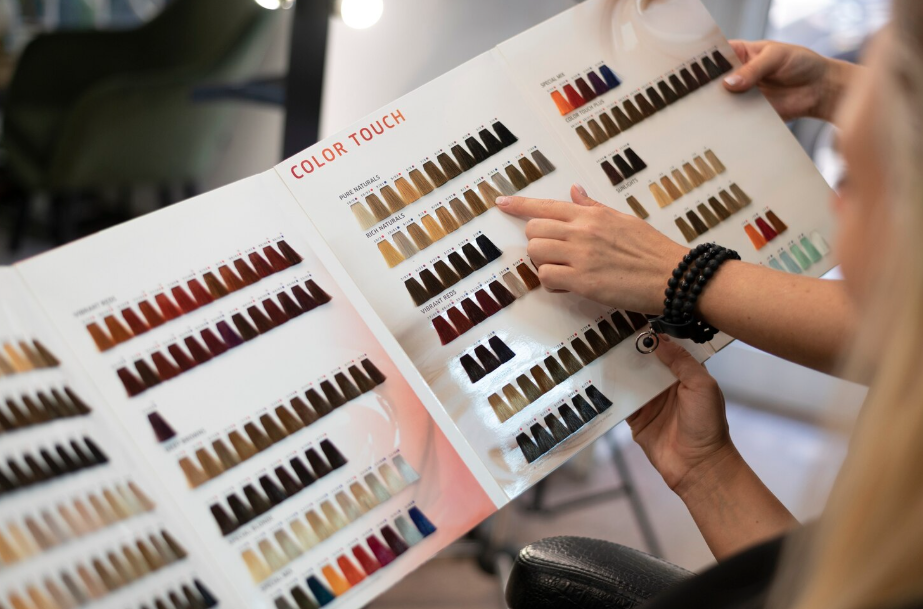
Reading and Mixing Color Formulas
Professional hair color lines use numbering systems that tell you everything about the color. While brands vary slightly, most follow similar patterns. The first number indicates level (darkness). Numbers after the decimal or slash indicate tone.
For example, in many systems: 6.1 might be level 6 ash, 6.3 might be level 6 gold, and 6.66 might be level 6 intense red. The more you see the same number repeated, the stronger that tone. Understanding your color line’s system is crucial—ask your educator or the brand rep to explain it thoroughly.
When mixing formulas, you’re combining pigment (color) with developer (hydrogen peroxide that lifts and deposits). Developer strength determines how much lifting occurs: 10 volume deposits only, 20 volume lifts 1-2 levels, 30 volume lifts 2-3 levels, and 40 volume lifts 3-4 levels. Higher volume creates more lift but also more damage, so choose wisely based on hair condition and desired result.
The Role of Porosity in Color Results
Porosity describes how easily hair absorbs and holds moisture and color. Highly porous hair (damaged, over-processed) grabs color quickly but fades fast. Low porosity hair (virgin, healthy) resists color absorption but holds it well once it takes.
When working with porous hair in your Illinois salon, you might need to pre-fill it with protein or use a color filler before applying your target shade. Without this step, color can look patchy or fade within days. Think of porous hair like a sponge—if it’s already waterlogged, it can’t absorb cleanly.
This is especially important for color corrections. If you’re lifting someone from dark to light, the ends will naturally become more porous than the roots. Understanding this helps you adjust your formula for even results.
Common Color Challenges and Solutions
Brassy Blonde: Excess warmth after lightening. Tone with violet or blue-violet based on whether yellow or orange is dominant. Many Illinois clients request cool-toned blonde, so mastering this is essential.
Green Cast: Usually from adding ash (blue) to hair with too much yellow, or from chlorine. Neutralize with red-toned color or use a color remover if it’s from pool chemicals.
Color That Won’t Lift: The hair might have previous color buildup, metallic salts from box dye, or protein overload creating a barrier. May need color remover before proceeding.
Uneven Fading: Different porosity throughout the hair. Address by using protein treatments to even out porosity, then recolor.
Color Too Dark: The level was too dark for the natural base, or you used too strong a developer. Can sometimes be fixed with clarifying treatments or color removers, but prevention through proper formulation is better.
Becoming a Color Specialist in Illinois
Many of the top-paying beauty careers in Illinois are in specialized color work. Master colorists in Chicago command premium prices because they consistently deliver results other stylists can’t achieve.
The path to mastery starts with understanding theory, then comes practice. Take every opportunity during your training at Cosmetology and Spa Academy to work with color. Practice mixing formulas, predicting results, and troubleshooting problems. Ask questions when results surprise you—those moments are the best learning opportunities.
Continue education after licensure through advanced color classes, manufacturer education, and learning from experienced colorists. The science of hair color is deep enough to study for an entire career.
Putting Theory Into Practice
Understanding color theory transforms you from a formula-follower to a true professional. You’ll consult with clients more confidently, explain why certain looks require certain processes, and troubleshoot issues that would stump less knowledgeable stylists.
Start by truly mastering the color wheel and the law of opposites. Everything else builds from that foundation. Quiz yourself: What neutralizes orange? What happens when you add ash to very yellow hair? What contributing pigment appears when lightening level 4 hair?

The stylists who succeed in Illinois’s competitive markets—whether you’re starting out or working toward opening your own salon—are the ones who never stop learning. Color theory gives you the foundation to build expertise that clients will seek out and pay premium rates for.